The itinerary from Trapani to Marsala is called the saltroute (la via del sale). Along the coast you will find the saline, salt-works where genuine mediterranean seasalt is produced with the help of the sun, a method in use since prehistoric times. Western Sicily can be considered one of the most important production area's of this salt and it is not a conincidence that this in antiquity was the territory where first the Phoenicians and later the Punics settled permanently. The itinerary is not very long but there is enough to be seen.
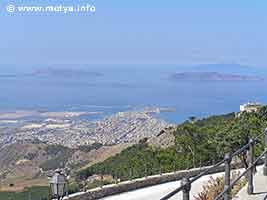
 Trapani
, in latin Drepanum, has been ever since ancient times an important port. Here the ferries connect the Egadian islands with Sicily, and ferries depart for Sardinia, Cagliari. The fishing industry has been always a very important economic resource and the fishmarket one of the most famous on Sicily. The historical center has been built in baroc style with magnificent facades. The Museo Pepoli, housed in an old convent, has a fabulous collection of fine artwork and paintings.
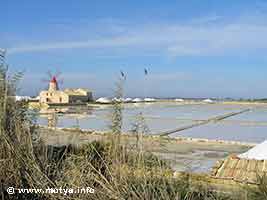 Saline di Ettore Infersa
From Trapani the first part of the itinerary leads to the salt-works just south of the town. The central mill in spanish style served to grind the salt before it was packed and sold. Now it serves as a small museum and there is a restaurant with a traditional sicilian kitchen, like the pasta alle sarde Next to these lie the saltworks of saline Calcara, also with a small museum.
The third salt-works along the route are those of the famous Ettore Infersa that can be found on the coast bordering the extensive lagoon of Marsala. Here too the central mill is a small museum and guides will explain the working of the saline. Seawater will be let in to the outer bassins. After some time the water is pumped into an inner circle of bassins with the use of smaller mills. At the point that the organic component of the seawater starts decaying the water will become reddish. In the last phase the bassins will contain the dried salt. The densely packed salt is loosened by hand and piled up on the banks to dry. In the winter the piles are covered with roof tiles. After the winter the salt can be grinded and sold.
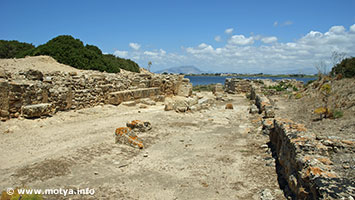
The boats for the island of San Pantaleo depart from the pier at the saline of Ettore Infersa. On this island in the middle of the lagoon of Marsala lie the remains of the ancient town of Motya (Mozia) devastated in 397 BC by the greek tyrant Dionysios. A tour around the island to see all the remains, the town walls, the Kothon, the necropolis, the tophet, the mosaics and the towngates, will take more than an hour.
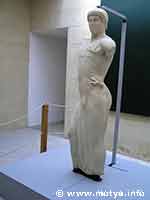
Near the landing pier stands the big house of Whitaker, the English family that owned the island, now transformed into a nice museum. Joseph Whitaker was interested in archaeology and he excavated part of the remains of Motya as a hobby. The museum contains a fine collection of artefacts from Motya and from Lilibaeum (Marsala).
After the visit to Motya the itinerary continues to Marsala, the famous town that gave it's name to the particular wine. The British navy was the biggest customer of the wineries at a time when the port from Portugal was more difficult to obtain which explains the heavy presence of English families that invested in Marsala. The town has a nice historical center. Along the coast lies the area of Lilibaeum, only partly excavated, and the museum with the punic ship, found in 1971 in front of the coast. The Museo Archeologico Nave Punica is housed in an former baglio, a large sicilian farmhouse. The itinerary ends here in Marsala.
Circumstances in reality can be different due to specific situations or changes on the roads. See also the disclaimer

Museum Whitaker
Marsala (TP)
The Museum Whitaker, housed in the former residence of the family Whitaker on the island of Motya, preserves a very unique collection of archaeological finds. Most renowned is the marble statue of the young chariotteer.

Mothia
Marsala (TP)
Motya, or Mothia, was the most important Phoenician-Punic town in West-Sicily, built on a small island in front of the coast. It had a large industrial quarter and in punic times was surrounded by a city wall and city gates to defend itself against the attacks of the Greek tyrants of Sicily.